CELIBACY AS GIFT
I think it’s a very important topic because there’s been a lot of crises over the past 50 years, 60 years. A lot of confusion.
Many of you are too young. Well, we are old, we remember it. The Pope Paul VI, there were a lot of priests who were living with priests to them in the 60s, those who are in their 70s like me.
And there was a lot of questioning whether or not celibacy should be obligatory. There was a lot of discussion right after Vatican II, Second Vatican Council. So given that we’re all men and we’re celibate men, and you have promises, we call it a vow, but it’s really the same thing.
We’re religious, priest, chastity, poverty, and obedience, but it’s really the same thing. And you probably haven’t studied too “much about it. Probably in your priestly formation, you have some courses on it.
Maybe not very deep, but I think it’s a topic we should really address for ourselves as well as for the community that we serve. I was preparing this talk about a week ago, and in the past hour I’ve been studying up, and I thought I’d give you some ideas on it. The first point I’d like to make is this, is that most people are called to the married life.
That’s the most common vocation, most. Some are called not to get married, nor to become priests or nuns. But most people are called to the married life, and thanks be to God, I’m here because of my mom and my dad, no?
So most are called to the married life. There is what is called the universal call to holiness, that’s Lumen Gentium Chapter 5, you’ve read the documents of Vatican II, Lumen Gentium Chapter 5, the universal call to holiness. But there are different pathways.
So what about us? We have been given a special gift. I was just reading a few minutes ago, Pope Paul VI, St. Pope Paul VI, I love, right, he is so easy to understand, Pope St. Paul VI.
By the way, he is a saint now, you probably know that, right? He was canonized with Romero, Cardinal Romero. He wrote, Sacerdosius Celebatis in 1967, which was a document on celibacy.
What do you call a celibacy for us? He calls it a brilliant diamond. Isn’t that beautiful?
What do you think? Isn’t that beautiful? It’s a brilliant diamond, it’s a treasure.
CHARISM
We have certain vocabulary as religious life, you’ve probably heard of charism. You’ve heard of the charismatic movement, but the word charism is a word we as religious use. We have a certain charism, like the Jesuits to give the retreats, the Redemptorist to give popular missions, Mother Teresa serving the poorest of the poorest or for a vow.
It’s called a charism. It’s a specific physiognomy that God has left to the church, usually through a founder or a foundress. But also celibacy, it’s a charism.
Another word for charism would be it’s a gift. So all of us have been endowed with that gift. And I think we should be overflowing with great gratitude that God has given us that gift.
I say gratitude, thankfulness that God has given us this special charism. So in my notes, I wrote down about five or six different ideas about this.
Okay, because we live in a world that is so saturated with sensuality and sexuality, no matter where we go, we’re bumping into photos and pictures and things on the internet. We’re being bombarded so much by today that there are, okay, more than one of you have told me that this Diocese has very few vocations, isn’t that true? Well, it’s very interesting because where we have tons of vocations is from Africa.
We have a house in Nigeria, and we have a thousand applications every year. We can only receive six. There are some Nigerians here, you know.
We can only receive six because we are poor and the house is small. But a thousand, that’s incredible. So you have, not that they would all be ordained priests, but here in the United States as “well as Europe, we are so bombarded by sensuality that there are young people that have the gift.
They have it. But I would say, I would say, they are not challenged. Sometimes they meet a young man that is praying, coming to daily mass, saying his rosary, and I will challenge him, hey, maybe you are called to be a priest.
Maybe we don’t have vocations because we are not as assertive, I didn’t say aggressive, but assertive enough in challenging young people to accept the call. So I believe there are more young people that are called to the priesthood than say yes. And that’s the next point.
ACCEPTING THE CALL
It’s a gift, but a gift has to be accepted.
Like all of us, we were challenged to accept a gift, and we’re here now because we said yes to the gift. But many have never accepted that challenge, and never said yes to the gift. Now we have St. Alphonsus in the back, one of my favorite saints.
“He wrote a book called Vita Religiosa, which is Italian for religious life. And he says that if you’re cold to the religious life and the priesthood, and you say no, can that person be saved? What do you think?
It’s a good question, right? He’s called and he says no. Alphonsus says yes, but it’s going to be more difficult.
It’s like trying to put a square peg in a round hole. I mean, you can do it, but try to do it. Because that was the specific vocation that God gave the person for sanctification.
So, if we were to have chosen the married life, not to say that we’d be damned, but it would be more difficult for us, because this is the vocation that God has given to us. Thanks be to God.
DEFENDING THE CHARISM
A gift that has to be defended and it has to be cultivated.
Remember, when I was in Argentina, I would do retreats with a group called Cristo Rey and Rosario. And I was, the founder was still living, and all the priests there, they would wear the religious habit. And, remember, on occasion, he said a lot of people would sometimes criticize those who wear the religious habit.
And remember what he said was this. They would say, “El hábito no hace monje.” He speaks Spanish.
“El hábito no hace monje”. And he responded, “Es cierto que lo define y lo defiende.” So if you don’t know Spanish, I’ll translate that for you.
The habit doesn’t make the monk, but he said, true, but it defines who he is and it defends him. Not that. It defines his specific consecration of God. It defends him against the attacks of the enemy.
And, it has to be, it has to be esteemed as that pearl, that diamond, that splendid diamond that Pope Paul VI speaks about, in his encyclical, Celibates, SACERDOTALIS CAELIBATUS Okay. Now, let’s talk about, let’s talk about how we can defend it.
Then, I like to talk about spiritual paternity. Because, you know, they call you Padre. I mean, if you speak Spanish. They call you Father! And I tend to be a friendly person. I tend to be sociable. I like the people. They like me as a whole. Not all, I’m sure. But, if someone would just come up to me and call me by my first name, if you do it, that’s fine, because we’re priests.
We’re brothers. But if a lay person would call me by my first name, I would gently correct them. I’m Father.
Because of the dignity of the priesthood, I am a spiritual father.
So, we should not have an identity crisis as to who we are. Many have an identity crisis. Do you remember when Colby, Max Main Colby, remember when he was on the concentration camp?
You ever read his life? I had the privilege of being at his canonization. I was a young seminarian.
What a great grace that was. When they took him aside when he’s offering his life for that man who had a couple of kids, they said, who are you? He said, I am a Catholic priest.
He did not have an identity crisis. Colby and me. I’m a Catholic priest.
So, to defend this charism, this gift, I’m going to give you several things. And I’d like to talk about how is it that we exercise our spiritual paternity? Because we’re fathers.
And it’s not so much that we negate our paternity, but we sublimate it. Sublimate it means we elevate it to a higher level. What a sublimate means is transcending the pure carnal or the natural.
That’s what it means. You never heard the word sublimate before.
A PEARL OF INFINITE PRICE
We will defend it by treasuring it as a pearl of infinite price. Jesus speaks that it is a pearl of infinite price. But also we have to pray.
We have to pray. This retreat is dedicated to praying, trying to go deeper in our prayer life. Maybe you have noticed, when you pray very little, you sin more.
Whereas, when you pray fervently, more crosses come. But you are able to resist the temptation, because God is stronger than our weakness. Amen?
Yeah. God is stronger than our weakness. We are weak, but God is very strong.
God is omnipotent, isn’t he? All-powerful. So we have to pray. Pray that we will be faithful. Not like Matthew 7, 7: “Ask and you will receive. Seek and you will find. Knock and the door will be open. Whoever asks, receives, oversees, finds, whoever knocks, the door will be open.” So, prayer!
PENANCE.
Second, we are in the season of Lent. The practice of penance. The practice of penance. Jesus says, some devils can be cast out only by prayer and fasting. How did Jesus conquer the devil? So, prayer, fasting and the Word of God, amen?
They can use the Word of God, right? Prayer, fasting and the Word of God.
In our spiritual life, if we want to soar high in the spiritual life, arrive at the horizons beyond our imagination, we have to have two wings, doing a prayer and penance. Prayer and penance are the two wings by which we can soar high in the spiritual life. We tend to shun from penance, and that’s why we have the season of length.
There was a priest that said if we really want to live out penance, there are three different activities. You give a tri-dimensional explanation of it. You got to go up, you got to go in, you got to go out.
Kind of like that. You got to go up through prayer, you got to go in through penance, you got to go out through almsgiving. Go up, go in, go out.
EUCHARIST
We have to receive the Eucharist with great love. Now, I say, that’s probably the most important thing. Same as, but receive the Eucharist with great love.
Now, if you had a heart problem, and you had someone who is going to donate you a heart, not that easy. You have to do a lot of tests to see if it’s compatible in the blood type, all that. But did you know that you “can have a heart transplant every day, every time I receive Holy Communion?
I’ll prove it. Receive Communion, receive the body, blood, soul, and divinity of Christ, right? What are the two most noble organs in the human person?
The mind and the heart. So when you receive Holy Communion, you receive the sacred heart of Jesus in your heart. And his blood is pumping through your own blood.
So we want to live celibacy, receive the sacred heart of Jesus with love every time you celebrate Mass. And ask the Lord, Lord, give me a new heart. And he will.
Some of you are thinking, there goes Father, he’s waxing poetic once again. It’s really not a metaphor, it’s the reality.
So in our struggles with what’s called concupiscence, maybe you heard that word before, concupiscence, the desires of the flesh, we see the sacred heart of Jesus, he’s able to come and conquer our passions. Amen?
“You believe it? We’re weak, but God is strong. We’re weak, but God is strong. Well, right. We’ve talked about confession. Confession is a very important sacrament. In each of the sacraments, you studied sacramental theology many years ago, you know, each sacrament communicates a different sacramental grace. What is the sacramental grace of the Eucharist? Nourishment.
What is the sacramental grace of confession? Healing. Did you know that?
Well, now you know. It’s different. Communion nourishes us with the body of Christ, with the body, blood, soul, and divinity of Christ.
But confession, it heals us. Confession is both curative medicine and preventive medicine. Got that? It’s both curative when we fall, but preventive too.
That’s why we as priests, we should go to confession frequently and invite our people to have frequent recourse to the sacrament confession. To heal the wounds and to prevent the wounds. So that’s a powerful means to help us to live out this charism that God has given to us.
EXERCISE OUR SPIRITUAL PATERNITY BY SUBLIMATING
By means of an interesting story I heard, the power of purity. Have any of you ever heard of Scott Hahn? No?
SUPPORT FOR CELIBACY
Have you ever heard of Scott Hahn? Scott Hahn is probably the most famous American convert. He teaches where my my nieces are going, Franciscan University or Steubenville. His conversion story hit like a million or something on cassette tape back in the early 80s. His conversion story is fascinating.
He said this, he was a Presbyterian before becoming a Catholic. Presbyterian would be the Church of Scotland as he comes to the United States. And if you have ever been to his library there in Steubenville, it is probably the biggest library you are ever going to see in your life.
A lot of books he has actually written. But he would wander, he would go into bookstores to buy new books. And this was before his conversion.
He could not resist going into the corner and looking at the bad magazines. He couldn’t resist it. It was like a magnetic force that pulled him to look at what used to be called the Playboy and the Penthouse, okay?
Those were the bad magazines. So you look at the book, but you always go there and browse to look at the bad magazines. Now, he wasn’t a Catholic.
Someone gave him a rosary. And to pray the rosary once as a Protestant, and he never felt the desire to go back and look at those bad magazines.
What do you think about that? What do you think about the Protestant? So we see even how the Blessed Mother, Blessed Mother can work in whatever way possible if we open up to Mary.
So experience shows those who really want to live a life of virtue, live out their promises, live out chastity, live out celibacy, be faithful to the married vows, be faithful to the priestly vows. The Blessed Mother is a powerful advocate. That’s why this whole four or five days you’ve been reading and meditating upon the Blessed Mother.
I hope that all of you fall in love with Mary wherever you go in your parish years, that you will instill great devotion to Mary. Amen? I’m an Oblate of the Virgin Mary.
It’s my charism to get as many people to have this love for the Blessed Mother as possible. And I will do that until my dying day. And I love to do it, promote Marian devotion.
All right. So those are some of the tools that we have to use. There’s more. One last thing I’d like to say on the human level.I know it’s easier said than done. Okay. Now, questions. Three questions to meditate upon. Do you get enough sleep? Do you eat properly and do you get a lot of exercise? Hello? I repeat. Do you have a good diet?
Do you get enough rest at night? And do you do exercise? Okay, two out of three.
No, really, exercise is important. Exercise is important because we tend to have a sedentary life where we are sitting down. So, not that you have to be a baseball player or a soccer player, but some type of physical exercise is important.
What I try to do is, there’s a gym right next to our church. I try to get out two or three times a week and I swim. I’m not going to break any record, but I’ll swim laps for about an hour.
We go back and forth, back and forth. I tell you, afterward I feel tired, but I feel like a new man. So, you might think about that in your priestly life.
GET SOME EXERCISE
Those three areas on the physical level, you eat properly, you get enough rest, and then you get enough exercise.
So, it’s often when our body is run down, that’s why we have temptations against celibacy, often when we’re run down, even physically, okay? Alright, so let’s talk about sublimating it. New word, huh?
Spiritual Paternity
We’re talking about transcending, in which we are called to be spiritual fathers. Now, maybe I’m saying something that’s obvious, but sometimes we overlook the obvious. We are spiritual fathers.
And people look to us to be spiritual fathers, that’s why they call us padre. They call us father. Think of all the different ways you’re exercising your spiritual paternity.
One of the ladies that works in our parish calculated I’ve already baptized 2,000 babies. That’s a lot. I mean, I’m old, and the priest, most of you, that’s quite a few.
Smaller parishes, maybe, baptism every other Saturday or something. But years ago, I was baptized in 25 to 30 almost every Saturday. I’m in LA, no? So every time you baptize, you say, John, I baptize you in the name of the Father, the Son, the Holy Spirit. You’re exercising your spiritual paternity. Yes. You’re generating spiritual life in that child that you’re baptizing. Or it could be an adult. Well, Easter Vigil Mass, right?
You’re exercising your spiritual paternity. Wow. And people come back to you and say, hey, Father, you baptized me ten years ago. Thank you. They’ll come back, you know, you baptize, I’ve arrived. You baptize me as well as my little son. I’ve been in the parish for thirty years. Because you’re baptizing two generations, huh?
Praise the Lord, huh? Okay, next would be, do you ever hear confessions? You hear confessions when you say, I absolve you of your sins in the name of the Father and of the Son, the Holy Spirit.
I did not give you general absolution though, okay? Okay, when I say absolve you of your sins in the name of the Father, the Son, the Holy Spirit, that spiritual generation that’s moving the person from, often from the state of sin to the state of grace, that person is being born again. St. Augustine, St. Augustine calls it a Lazarus experience.
Remember Lazarus? When Jesus said, Lazarus, come out! The man was dead and he was brought back to life. Every confession is a Lazarus experience. Lazarus, come out. Okay, next. I mentioned this in my earlier talk. The greatest action we can do, this side of eternity, is to celebrate the holy sacrifice of the Mass. So, every time you are celebrating Mass, you say, this is my body, this is my blood. What’s happening? Jesus is being born in your hands.
Spiritual paternity, Jesus is being born in your hands. And when you give out Holy Communion to those people, he is being born in their hearts.
You see, by living out Priestly Celebrity, we’ve got more freedom. We love God with an undivided heart. It’s an eschatological sign. It’s a sign that there is something beyond the grave. That’s what Paul VI in Vatican II as well as the Canon Law speaks about. It’s not something negative. It’s something positive. It gives us freedom. The freedom of the sons and daughters of God. We’re free. How many people are slaves of their sexual passions? I say most people today.
They’re actually slaves of their passions. Thanks be to God not to say the word perfect are angels, but this is a great gift. It gives us freedom.
Freedom of the sons and daughters of God. And then with your permission, I’d like to give you once again a little bit of St. Augustine. This idea of Augustine I love.
So we as priests, you read through Presbyterorum Ordinis, which is the document of the priesthood from Vatican II. The document says that we have two principal obligations. Remember the two P’s.
We’re called to pray, we’re called to preach. Amen. We’re called to pray, but also we’re called to preach.
We’re called to preach, I say the third would be penance still. We’re called to pray, to preach, and penance, the three P’s. And maybe four, pray, preach, penance, and priesthood.
Oh, there we go, the four, I have to find a five, a wrong number. So this is what Augustine says. Okay, you got Mass at 8 o’clock. You’re in the church at 7. And what are you doing? You are, with your eyes, you’re reading and you’re meditating upon the first reading, the psalm, and then you’re meditating upon the gospel. You’re meditating upon it. So the Word of God, it goes where? From your eyes to your mind.
It’s up here, in your memory, in your understanding, in your imagination. And then, where is the Word of God? It sings down into your emotions.
From there, it goes down into your will. And it sings down even to your very soul, the Word of God that you meditated upon with your eyes. There you have it. But we’re halfway there. You go there and you’re preaching. So you open up your mouth, and the Word of God that was in your mind, your emotions, your heart, your soul, you open your mouth and there are vibrations.
These vibrations are words. These words are concepts. These concepts are spiritual ideas.
They go into the ears of the people in your parish, and from your ears they go into their mind, and from their mind they go into their heart. So the word of God that was in your heart is now in their heart. Don’t you love it?
That’s Augustine. I love that. Maybe you are not aware of doing it, but that’s what you’re doing every time you’re preaching.
That can be one of the greatest acts of charity in the world, is to preach the word of God that goes from your heart into the heart of the people that you’re serving. That is Spiritual Paternity. So my friends, I think we should really rejoice, rejoice that we have this great gift of Spiritual Paternity.
FRUITS OF CELIBACY
There are many graces and many fruits that come from this. What are the many graces and many fruits that come from this? By living this out, we experience great peace of heart, great interior peace.
St. Augustine also tells us what is peace? Peace is the tranquility of order. Once we have a well-ordered spiritual life, then we experience peace of mind, heart, and soul.
JOY. Another fruit that comes from this is joy. Joy of knowing God loves us and joy of sharing the love of God to others. In God, in his church, he wants to have priests that bring, in the words of Pope Francis, his first encyclical, the joy of the gospel.
The joy of the gospel is one of the most efficacious means to bring people back to the church. That was the first encyclical of Pope Francis. Long encyclical in which he spoke that if we are followers of Christ, we should be radiating joy to the people that come to us.
Joy. They suffer sorrows and they are knocked down. We have to pick them up by the joy the way we live.
Another fruit would be by living out this promise, this charism, this grace of celibacy. We no longer, this is the theology of the body of Pope John Paul II. We don’t see, we never see a person as an object to be utilized or exploited.
But rather we are able to see people, see people as created in the image and likeness of God, but also able to see people as sons and daughters of God. That we are the spiritual fathers and they are our spiritual children. We are exercising our spiritual paternity.
And then another fruit would be the good example we give to many people that are struggling with their own passions. And it’s true. Either we dominate our passions or they dominate us.
I repeat, either we dominate our passions, we dominate, we subjugate them, or they will dominate us. It’s either the freedom of the sons and daughters of God, or it’s slavery. And Jesus says that sin is slavery.
Sin is really slavery. And then, if we’re living out this wonderful virtue, our communions en masse, our masses are going to be more fervent and more efficacious for the sanctification of our people as well as the sanctification of the church at large. Now John Paul II said this, when we do good, we elevate the whole world to God.
When we do evil, we bring the whole world down to the lower world. This is called the social aspect of our spiritual life. We’re not islands, but rather we influence other people, either for good or for bad.
And then, in this I mentioned, by living this out, we’re able to establish a really deep friendship with Jesus, Mary and Joseph. They become our best friends. In a certain sense, loneliness exists.
True, loneliness exists. But at the same time, we’d have to say this, that if we have Jesus, Mary and Joseph as our best friends, not too much loneliness, because we’re in really good company. Pope Leo XIV, in his last apostolic letter, which he actually wrote to priests, he wrote that about five weeks ago, commemorating the 60th anniversary of PRESBYTERORUM ORDINIS and Optatam Totius which were the church documents from Vatican II, he said this, that priests do suffer loneliness and they should try to find bonds of community.
Like for me, I’m a religious priest, so I live with seven or eight priests, you know. But you who are a diocesan priest, the Holy Father says it’s a good idea to form some type of community among yourselves. Like this week is very important because even though we’re not talking too much to each other, we’re talking to God, there’s a certain bond of community of those in the diocese of Gallup, as a result of this retreat, to have some type of bond of community.
And finally, if we really live out the vow, rather the promise of celibacy, it sparks within us what is called apostolic zeal. Apostolic zeal which is, as I mentioned earlier in the morning, a real desire to work to save a lot of souls. To work to save a lot of souls.
So let’s pray for each other for this grace that we would be able to really live out our promises, live out our commitments with a lot of joy, a lot of love and a lot of zeal. And if we fail in one way or another, never stay down, but rather bounce back, okay? Because only God is perfect.
If we fail, bounce back and try to love God more and more each day. So hopefully this is helpful for us because you don’t hear a talk on this too often. Now in the context of a retreat, let’s pray for the grace to be faithful servants of Jesus, Mary and Joseph.
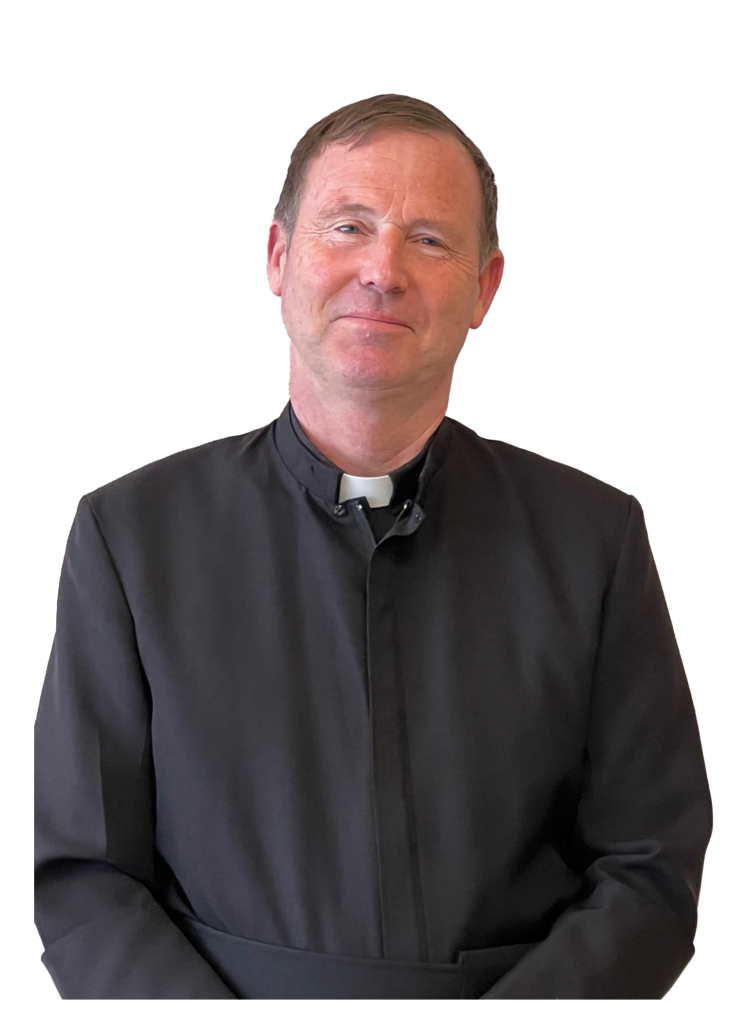
Fr. Ed Broom, Oblates of the Virgin Mary


